Research in the Watts-Fawkes lab centres around three themes. The themes all relate to improvement of crop yield or nutrition with arbuscular mycorrhizal fungi, in the context of Australia’s harsh soil and climate conditions.
i) The impacts of arbuscular mycorrhizal fungi (AMF) on micronutrient bioavailability in cereal crops. We are particularly interested in how AMF that colonise rice and wheat plants, affect the production of phytate in grain. Phytate is an “anti-nutrient” and its concentration in grain has important implications for how well zinc and iron are absorbed in the human gut when we consume rice and wheat products.
Funded by: Australian Research Council. Personnel invovled: Diem Nguyen, Wen Yan.
ii) Understanding the role of AMF in aerobic rice production systems, with the goal to increase water use efficiency. Rice is typically grown in flooded paddies, where the symbiosis with AMF is not functional. As we move to aerobic (non-flooded) rice production in Australia, we have an opportunity to use AMF to improve nutrient and water uptake. We use the DroughtSpotter platform at the Australian Plant Phenomics Facility in Adelaide.
Funded by: AgriFutures Australia. Personnel involved: Ali Gill, Diem Nguyen.
iii) Eliciting the function of arbuscular mycorrhizal fungi in PFAS contaminated soils. Particularly, quantifying effects of AMF on the host plant with regards to PFAS uptake and resilience to contamination. This will provide information on whether AMF can be used to limit bioaccumulation of PFAS in the food chain. In collaboration with Dr Shervin Kabiri.
Funded by: Primary Industries and Regions South Australia, Yitpi Foundation.
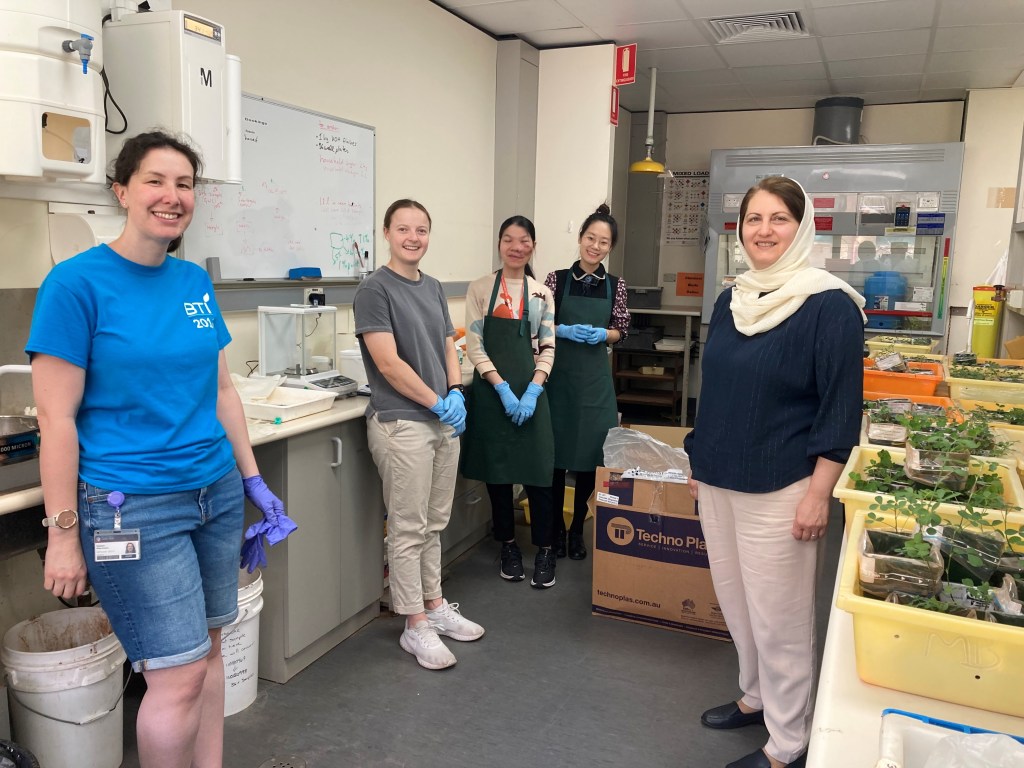
 Dr. Stephanie Watts-Fawkes